MAT Governance 101
This is the place to start for a crash course in how academy trusts are governed, who actually holds the power, and why bringing CofE and non-faith schools together makes these governance arrangements particularly important.
It sounds dry.
It isn’t.
(But maybe that’s just me!)
A mixed MAT means a new governance structure for Learning Partners
The 3 trusts include both non-faith and CofE schools. The merger therefore needs a governance structure that accommodates both. Which means the the governance structure of the ‘to be’ Trust will need to change.
Why does that matter? Because a MAT is one legal entity. The people at the top ultimately govern ALL the schools within it.
The merger therefore requires decisions about the governance of the new organisation:
- its Articles of Association,
- its Members,
- its Trustees,
- how those people are appointed,
- what powers or appointment rights are held by other organisations.
Those decisions will ultimately determine who governs every school within the merged trust.
If academy governance is new to you, this is the basic structure you need to understand
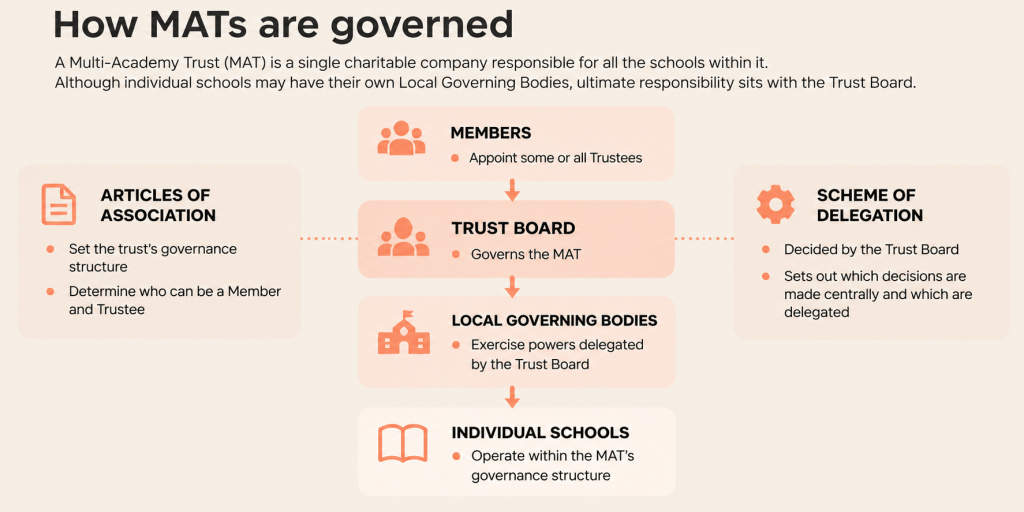
How MATs are governed
A Multi-Academy Trust (MAT) is a single charitable company responsible for all the schools within it. Although individual schools may have their own Local Governing Bodies (LGBs), ultimate responsibility sits with the Trust Board.
There are three main layers of governance.
Members
Members sit at the top of the trust’s governance structure. They are sometimes compared to shareholders, although they do not own the trust or receive profits.
They have relatively little involvement in day-to-day decisions, but they hold important constitutional powers. These include appointing some or all of the Trustees and removing Trustees.
How Members themselves are appointed is set out in the trust’s Articles of Association. Depending on those Articles, existing Members or specified organisations may have the right to appoint new Members.
Trustees
Trustees are the people who actually govern the MAT.
Together they form the Trust Board and are both charity trustees and company directors. The Board is responsible for strategy, educational performance, finances, safeguarding and ensuring that the trust meets its legal obligations.
Trustees govern the trust as a whole, rather than representing individual schools.
The Articles of Association determine how Trustees are appointed. Some may be appointed by the Members, while the Articles can also give particular organisations the right to appoint Trustees.
Local Governing Bodies
Individual schools normally have a Local Governing Body (LGB).
However, an LGB does not have independent authority in the same way as the governing body of a maintained school. Its powers are delegated to it by the Trust Board through the trust’s Scheme of Delegation.
This is why the governance arrangements for the proposed merger matter.
The key questions are not simply who sits on individual school governing bodies, but who the Members and Trustees of the merged MAT will be, who will have the right to appoint them, and what powers will be delegated to individual schools.
The answers will determine where ultimate decision-making power sits across the new trust. And importantly, this doesn’t affect just the next 2 or 3 years. But the entire future lifespan of the Trust. An individual school cannot, ever leave a Trust. There simply is not mechanism through which this can happen.
Articles of Association
The Articles of Association are effectively the constitutional rulebook of an academy trust.
They establish the trust’s governance structure and set out matters such as who can become a Member, who has the right to appoint Members and Trustees, how Trustees can be removed, how decisions are made and how the organisation itself is governed.
Changes to the Articles can therefore change who has formal influence over the governance of the trust.
Scheme of Delegation
The Scheme of Delegation answers a different question: once the Trust Board has the legal authority, how much of that authority does it choose to exercise centrally and how much does it delegate?
It sets out which decisions are made by the Trust Board, which are delegated to executives, and which can be made by Local Governing Bodies or individual schools.
This might cover areas such as budgets, staffing questions, or recruiting say the headteacher, admissions, policies and the appointment of local governors.
Unlike the Articles, the Scheme of Delegation does not give an LGB independent legal authority. The powers exercised locally have been delegated by the Trust Board.
The Scheme of Delegation can be easily changed, at any point, by the Trust Board. What is delegated today, may not be in 5 or 10 years time. Rights and authorities of LGB can easily be reversed (and there are several examples of this happening…)
Why the CofE bit is crucial…
This is an important piece of this puzzle.
In a non-faith MAT, Members and Trustees are generally appointed through the mechanisms set out in the trust’s Articles. The trust can recruit people because of the skills, experience and perspectives it believes it needs.
CofE governance is different.
The religious character of a CofE school comes with formal governance protections.
When CofE schools become academies, the Church requires governance arrangements which protect their religious character. Depending on the model adopted, this can include formal rights for the relevant Church or diocesan body to appoint Members, Trustees and local governors.
That creates an important issue when CofE and non-faith schools are brought together in a single MAT. The constitutional arrangements of the receiving trust have to accommodate those protections.
This means that Learning Partners will be inevitably giving some of its control to the Diocese. How much is unknown. And whether this is too much will depend on your point of view.
[I am strongly secularist and therefore ANY interference from the CofE (or any religious authority for that matter] in our state schools is too much. ]
The key questions for me are:
- How many Members will there be?
- Who will appoint them?
- How many Trustees will there be?
- Who will appoint them?
- What appointment or consent rights will the Diocese or other CofE bodies receive?
- What will this mean for schools with no religious designation?
- And ultimately…

LEarn MOre
Four things that tell you almost everything you need to know about this merger.

